Parents Nagarani and Kathirvel


Countries: India, The Netherlands
Agencies:  Malaysian Social Services, Meiling

Nagarani and Kathrivel’s son was kidnapped during the night in Chennai, India. Five years later the kidnappers were arrested and they confessed that her son had been sold to an orphanage Malaysian Social Services Chennai and subsequently was given for adoption to adoptive parents in the Netherlands, through the mediation of a Dutch adoption agency.

ACT retraced the child in the Netherlands. The adoptive parents have so far refused to cooperate in DNA testing, to proof that the child is indeed Nagarani’s. ACT helped this Indian family to find a Dutch Attorney and to file a Court case in the Netherlands that took place in June 2010.

After two weeks, Nagarani and Kathirvel went back to India. Without even having met the adoptive parents, who did not appear in Court.

The Family Court of Zwolle-Lelystad has ruled on March 4 2011 in the case. The Indian couple’s request for a DNA test to determine that a boy adopted by Dutch parents is their biological son, was dismissed by the Court.

On 13 September 2012 the Dutch Appeal Court also dismished the Indian’s parent’s request.

ACT is working on further actions.

If you would like to support Nagarani and Kathirvel:

Or bankaccount:
Against Child Trafficking, the Netherlands
Bank Account 67 26 82 060
IBAN: NL41 INGB 0672 6820 60
BIC: INGBNL2A

Related news:

Adoption ‘Orphanage’ Preet Mandir

Since last 10 years Preet Mandir has been under suspicion of sourcing children from poor families and selling children for intercountry adoptions.

Advait Foundation from Mumbai & Sakhee from Pune filed a Criminal Writ Petitions against Preet Mandir in Mumbai High Court and High Court recently ordered CBI to reinvestigate, as a previous investigation had proven to be faulty and incomplete.  The order of reinvestigation was challenged by Preet Mandir in the Supreme Court of India and the same was dismissed, precipitating in continuing the reinvestigation in unearthing the crimes committed by Preet Mandir.

On 7 March 2011 six persons were charged with criminal conspiracy for child trafficking.

The six accused are

  • former managing trustee of Preet Mandir Joginder Bhasin (72),
  • his wife Mahinder Bhasin (68),
  • son Gurpreet Singh (43),
  • Superintendent of Vasudev Babaji Navrange Balakashram of Pandharpur Vasudev Gangadhar Darshane (60),
  • social worker associated with Preetmandir’s Kalyaninagar unit Chandrashekar Admane (40) and
  • chairman of Child Adoption Resource Agency (CARA) Janindrakumar Mittal (55).

CHARGESHEET PREET MANDIR: AVAILABLE HERE

Related articles:

Grandmother Kisabai Lokhande

Grandmother Kisabai Lokhande placed her two grandchildren in for temporary care, education and protection in the Observation Home Satara (boarding school). From there the girls were transferred to the children home Preet Mandir in Pune.  From there the two grandchildren were, without their grandmother’s consent or knowledge, given to adoptive parents in Spain the mediation of a Spanish adoption agency.

ACT supported the grandmother in filing a Criminal Writ Petition against the State parties and Adoption Agency in the Indian Court. The Court dismissed it.

Following this, ACT supported the grandmother to file her case in the Indian Supreme Court.


Father: Ramesh Kulkarni

Countries: India, Denmark
Agencies: Preet Mandir, AC International Child Support (AC Børnehjælp)

After the death of his wife, Ramesh Kulkarni placed his four children for temporary care and protection in Preet Mandir. When Kulkarni arrived to meet his children a few months after leaving them at Preet Mandir, he was able to meet only two. He was told the other two were in hospital, and was advised he should keep his visits to a minimum to avoid “disturbing” the children. Later, he said, his parents went to the orphanage to bring the children back but the agency demanded Rs 50,000 as the price for each child’s discharge.

Then it came out his four children were adopted by a Danish family.

The owners and social worker of Preet Mandir and the then Chairman of the Indian Central Authority were formally charged by the Indian Central Bureau of Investigation (CBI) on 7 March 2011 of having entered into a criminal conspiracy with as motive to send children into adoption and to extort huge money from the adoptive parents.

Related news:

Adoptee Jennifer Haynes

Adoptee Jennifer Haynes was placed for temporary care and protection in an orphanage by her mother when she was 5 years old. Without her mother’s consent, in 1989, the Indian Courts orders were obtained by one Trust of a US adoption agency. She was abused by her adoptive father, and the adoption was ended.

She also got abused by the second adoptive family, after which she ended up in the US foster care system. After a conflict with the law she was convicted to jail. After finishing her jail term, the US deported her back to India as apparently her adoption though finalized; her US Citizenship was not processed by the American Adoption Agency (AIAA) through her Adoptive Parents. Jennifer has two children aged 5 & 6 (apparently US Citizens) who are living with her mother in law in the US. This being one of the worst punishment that a Human Being is made to suffer, that Jennifer, a Mother of 2 minor children cannot enter the country US, when her own minor children as US Citizens.

Jennifer’s papers are in possession of ACT. The research done by ACT, their Attorneys, it is evident that the Indian Authorities as well as the US Authorities have been unjust to Jennifer as well as her 2 minor kids, by mechanically deporting her from US and having accepted her in India as any ordinary illegal expatriate.

ACT is supporting Jennifer in Petitioning the Courts, against the Adoption Agencies in India and in the US as well as the Authorities. ACT with their expert Attorneys in India and US, in working out modalities seeking legal intervention and assistance finding ways to send Jennifer back to the US, reunite with her children and claim compensation and damages.

If you would like to support Jennifer’s case:


Related articles: Arimidex

Adoptee Anisha Mörtl

Countries: India, Germany
Adoption Agencies: St. Theresa’s Tender Loving Care Home

Anisha was born in 1992 and was taken by the ‘Tender Loving Care Home’, because her mother Fatima could not pay the hospital bill.   Sister Theresa then had her adopted by a German couple. Fathima did not see her child for the next 28 years.

ACT helped Anisha to retrace her mother.

Related articles:

Madonna – Malawi

In Spring 2009 ACT teamed up with Malawi’s Human Rights Consultative Committee (HRCC), a network of 80 locally-based civil rights organisations, and paid a lawyer to help preventing Madonna breaking Malawi’s adoption law.

Kairi Shepherd – at risk of deportation

Countries: India, United States
Adoption Agencies: International Mission of Hope (IMH) and Americans for International Aid and Adoption (AIAA)

Kairi was adopted, at three months old, by an American woman. This adoptive mother died when Kairi was 8 years old.

Kairi was unaware that her adoptive mother had not finalised the procedures to get her US citizenship.

Kairi is now at risk of being deported back to India.

ACT is working tirelessly to prevent this deportation from happening.

Adoptee Arun Dohle

Countries: India, Germany
Adoption Agency: Kusumabai Motichand Mahila Seva Gram (KMMSG)

Arun Dohle was adopted by a German couple in 1974.  He is searching his mother since 1993. As KMMSG refused access to his adoption file, he has petitioned the Indian courts.

Related articles:

Mother Declah

Countries: India, The Netherlands
Adoption agencies: Malaysian Social Services, Meiling

Declah placed her childen in an orphanage run by the Malaysian Social Service. The adoption agency assured her that it would educate the children and send them to her when they were 18 years old. She gave up four of her children. While two were returned to her, Melissa and James Kapil were put up for adoption abroad without her knowledge.

When a major scandal broke out in 2005, she learnt that the adoption agency had kidnapped and sold several children to couples abroad. Dekla immediately rushed to Chennai, but there was no trace of her children. Their foster parents had separated legally and Melissa and Miquel were placed in a government-run home in the Netherlands. 

ACT helped Declah to retrace her children.

Related articles:

Adoptive Parents Julia and Barry Rollings

Countries: India, Australia
Adoption Agency: Madras Social Service Guild Orphanage (MASOS)

In mid-1997 the Indian adoption agency MASOS told the Rollings that a three-year-old boy and his two-year-old sister were put up for adoption five months earlier, in October 1996, as their ‘terminally ill parents’ were unable to take care of them.  Eight years later the couple was stunned to read an internet article saying a member of the staff of Madras Social Service Guild Orphanage had been arrested on charges of kidnapping. “Early 2006 they heard that the director of the children’s orphanage of MASOS had been arrested in an unrelated case.

The Rollings have reconnected their adopted children with their mother.

ACT helped retrace the mother and assisted the Rollings in 2008  in filing a Writ Petition in the Indian Court.

Related articles:

Open letter to the UN Committees

Amsterdam, 21 September 2023

To (via email):

• The Committee on the Rights of the Child;
• The Committee on Enforced Disappearances;
• The Special Rapporteur on the Promotion of Truth, Justice, Reparation and Guarantees of Non-recurrence;
• The Special Rapporteur on the Sale and Sexual Exploitation of Children including child prostitution, child pornography and other child sexual abuse material;
• The Special Rapporteur on Trafficking in Persons.

Dear Sir/Madam,

Re: Objection about the UN’s promotion of intercountry adoption

We watched the event regarding the first anniversary of the UN’s Joint Statement on Illegal Intercountry adoptions (20 September 2023).

On the one hand, we appreciate that the UN committees have taken up the issue of intercountry adoption and given victims a voice and platform.

On the other hand, we are concerned that you advocate for better implementation of the Hague Adoption Convention and seem to believe that the current system of intercountry adoptions is legal.

From its inception in the Second World War, the intercountry adoption system has been riddled with child trafficking scandals. No amount of reform will improve a system that strips children of their identities, takes away their families and cultures, and places them in an alien land.

In our opinion, current intercountry adoptions are illegal, as most are carried out in violation of the subsidiarity principle of Article 21b of the United Nations Convention on the Rights of the Child.

We are a Dutch NGO and due to our work in exposing the corruption of intercountry adoptions in more than 17 countries, the Dutch government set up a committee to investigate intercountry adoption (COIA). In February 2021 the COIA released its report and one of its conclusions was:

“The current system of intercountry adoption with private elements cannot be maintained. The committee has serious doubts as to whether it is possible to design a realistic public law system in which the observed failures do not recur.”

We urge the UN Committees to respect the UN Convention on the Rights of the Child and to refrain from advocating for the Hague Adoption Convention, which contradicts it.

The UN Committees must request States to stop intercountry adoptions altogether and ensure that all victims get compensated and assisted.

Yours sincerely,

Arun Dohle

Reaction to France Inter’s reporting on so-called lucrative profit-making search business

Yesterdays French reporting on the so-called lucrative profit-making search business calls for some clarification from our side.

Against ChildTrafficking (ACT) is a registered non-profit organisation in the Netherlands.

Adoptee Rights Council (ARC) is a registered non-profit organisation in India.
Therefore we are per definition not for profit.

Together ACT and ARC run a professional office on investigating child trafficking, as well as offering searches for Indian adoptees. We employ/contract qualified staff. Arun Dohle, as founder and director is not paid a salary, but gets an allowance for expenses.

On average on each search case we spend 200 – 400 working hours. As an organisation we cannot operate below 50 EUR per hour including all overhead cost. At best we would need something between 80 – 100 EUR including all expenses.

Whoever has tried to search in India; knows that it is usually very hard. Arun Dohle has dedicated, not entirely voluntary, his life to assist adoptees and to spare them the nightmare he has faced during his 17 year long search.

The article, while not mentioning the name or link, refers to the “Adoptee Solidarity Fund”. The reporting implies that this is the ultimate profit, a search for 20.000 Euros. Not so. This model, based on solidarity and case per case, has proven the only workable way to finance the searches. It was developed some six years ago and has proven its success in the meantime. As long as there is nobody else takes responsibility for financing repair, and in the absence of State funding, this Adoptee Solidarity Fund made our work sustainable and worked miracles (even when we had like anyone else a backlash due to Covid).

It is not ideal at all; but funding is out of sight as it is given only to ISS associated organisations.

There is no profit and it is a grave insult and rather defamatory to suggest this. The “Yann” quoted is not known to us. The journalist could have contacted us. It seems a rather clear attempt to defame all private searches, in order to steer all funding to the Hague/ISS system, like was done in The Netherlands – Almost 40 million euro for a new Expertise Center (INEA).

We appreciate that the issue of the unregulated search market is being highlighted.

Since long do we advocate for compensation for victims/adoptees and sufficient funding to finance the work of organisations which assist adoptees re-connecting with their families.

Furthermore, there need to be standards and operational protocols that detail the role and rights of all parties involved, last but not least out of respect for the mothers. During the design process of the Dutch Expertise Centrum INEA we have plead for all above points. To no avail. The small projects available for searches by adoptee organisations, are too small and rather unworkable.

Adoptee leaders nowadays plea no more for compensation, but just for a small amount +- 5.000 euros to be given to each adoptee for their searches. That exactly will further stimulate a private market in roots searchers in which middlemen of all kind will operate: tourist guides, former child recruiters, adoption facilitators.

It is hard to find back families. The failure is not with us, nor are we commercial as suggested. The failure is with the receiving States who in the first place allowed our forced migration/trafficking, mostly without birth certificate and relinquishment documents. Our identities were erased. The failure is also with “International Social Service” whose then Indian correspondent Indian Council of Social Welfare (ICSW) who advised the Indian Courts in each and every adoption since 1972.

The very same International Social Service Network is now funded by the Dutch and French governments. Earlier the Australian government funded ISS as well.

ISS has never solved cases in India. They tried setting up a roots programme, and failed.

The State funded INEA, embedded in FIOM which is ISS per definition, does not carry out searches for adoptees. They give tips and/or refer to other organisations, such as ours.

To portray us, a professionally run organisation that serves adoptees successfully, as criminals who exploit adoptees for financial gain is below the belt.

France Inter has the audacity to republish parts of our website, but neither link to it or name us, nor contacted us.

Yes, the numbers cited are correct. I can proudly say that we solved since 2004 more than 80 searches. It is tons of work and it costs money. As long as ISS gets the State funding? We do not have a choice; other than to operate funded through the solidarity of the adoptee community.

Reply from the Ministry of Justice

ACT had decided to support the idea of an independent Expertisecentrum. We still believe that something like this is needed. Therefore we participated in the meetings regarding the design process as far as practically possible as digital attendence was often not allowed.

We insisted that organisations which assist adoptees get sufficent funding to assist with a high quality of service adoptees and their families. It became very quickly clear that there will not be much funding available and the major chunck of funding willl go to the FIOM/ ISS.

ISS / FIOM is very much the architect of the system and cannot at all be considered “independent”. They even were directly involved in adoptions and clear cut trafficking.

We started to complain hard, the moment the Minister informed the Tweedekamer that the Expertisecentrum will be embedded in within FIOM/ ISS.

First complaints were not even acknowledged and replied to. We turned to the Ombudsman, they played it back to us.  What a theater.

Adoptees should be aware of how the Ministry actually suffocates and hampers the work of organisations who have a track record and assist adoptees since decades with their roots searches, sucessfully.

Adoptees are being played against each other instead of facilitating good cooperation, fairness and exchange of expertise.

We still believe that there are other organisations, who could have set up the Expertisecentrum in a rather short amount of time. To say there is only FIOM is not correct. It is a lie.

Therefore the ministry violated public procurement regulations.

Think and read for yourself:

Here the response of the Ministry:

Dutch:

Reactie op uw bericht van 27 augustus 2022

Google translated English:

ENG Reactie op uw bericht van 27 augustus 2022

I ask myself every day who I actually am

(unpolished google translation)

Source: DER SPIEGEL 3/2023 

By Fiona Ehlers; January 13, 2023, 1 p.m.

Since the 1960s, 60,000 children from countries such as Chile
and South Korea have been adopted in Sweden – some have
been sold, others even stolen. Now some are asking for
clarification.

Occasionally, when he is pensive or lonely, Patrik Lundberg sits
with Astrid Lindgren. In Tegnérlunden Park, near Stockholm
Central Station, there is a small memorial in her honor in the
shade of a tree. Lundberg’s Swedish adoptive parents once read
him from “Mio, mein Mio”, the story of the orphan boy who comes
to this park when he misses his father, the king in the land far
away – and all around the windows are lit up and children sit
together their mothers and fathers. Patrik Lundberg knows this
feeling.

Lundberg, a reserved Swede with a fondness for
Vikings and football, is a reporter for Sweden’s highcirculation newspaper, Dagens Nyheter. About two years ago he uncovered a scandal. In the series of articles “Children at any price,” he and two colleagues
highlighted the fate of individuals who were illegally
adopted. They started a debate about Swedish parents
who, often because of misunderstood mercy, saved
children – children who didn’t need saving at all. Lundberg’s
research found that in at least 11 countries, infants were
taken away, pronounced dead, or bought from mostly poor
parents.

“We were able to prove,” says Lundberg that
afternoon in Lindgren Park, “like Sweden Courted
dictators it officially despised: How it supported China’s
long-standing one-child policy by taking in the banned
siblings. Or South Korea’s patriarchal system that made life hell for unmarried
mothers.

A system came to light, a kind of child trafficking,
certified in a state that for a good year saw little reason
to question its adoption policy. – to be a pioneer in human rights, a moral model nation – falter as much as in the Child adoption from abroad. Because no other country in the world has adopted
so many foreign babies in relation to the number of
inhabitants. Since the 1960s, children from more than countries raised. There were always suspicions again, fake birth certificates, rumors of kidnapping;
Diplomats have been warned about so-called “pillow adoptions” – that is, women who steal other
people’s children by sneaking into maternity wards with pillows in front of their stomachs and leaving with babies in their arms.

To this day, foreign children are adopted in Sweden, much
less, but still under dubious circumstances, says Lundberg.
And also from countries like China, Vietnam and India,
which have signed the Hague Convention on Intercountry
Adoption, according to which children their countries should of be origin raised in
whenever possible. “As a journalist, I’m fighting,” says
Lundberg, “to prevent that.” Born as Kim Jong-dae in South Korea Lundberg’s research has prompted the Swedish government to investigate all adoptions since the 1950s.
A team from Uppsala University is currently investigating
whether there were any irregularities on the part of the
state, such as judges declaring adoptions legal and how
state-controlled placement agencies such as the Adoption
Center operated. They want to be finished by the end of
this year, “but we’ll probably need much longer,” said chief
investigator Anna Singer, whose official trips she last went
to Chile and Colombia led. There, too, illegal placements
and even suspected child abductions took place. And not only in Sweden, but also in France, Belgium, Switzerland and occasionally in Germany, adoptees have joined forces and demand
clarification. In the Netherlands a similar investigation into children
adopted from abroad led to an interim freeze on adoption.  Many of the Swedish activists want a ban on international adoptions and an institution that supports adoptees
and their adoptive parents – psychologically and financially. In Stockholm
the enlightener Patrik Lundberg is a middleman, he collects their stories and
establishes connections between adoptees from India, Chile, South Korea.

Lundberg himself was born as Kim Jong-dae im
in Busan, South Korea, and was adopted by Swedish parents when
he was six months old. For a long time he thought he was an isolated case.
He got his from a tattoo artist
And not only in Sweden, but also in France, Belgium, Switzerland and
occasionally in Germany, adoptees have joined forces and demand
clarification. In the Netherlands with . A similar investigation into children
adopted from abroad led to an interim freeze on adoption.
Get case number stitched on left forearm, /SJH. For Lundberg it is a kind of raison d’être, his guaranteed identity. When Lundberg was years old, he traveled to Seoul to learn Korean,
where he met other adoptees from Europe who had similar questions
about their origins. The Korean recruitment agency gave him his parents’
address, but when he drove there, he hugged the wrong people. They are
only relatives, the Koranic couple explained to the shocked Lundberg, the
real parents were too young at the time. Therefore, one would have had to
cheat with the information, otherwise the mediation would never have come
about. Lundberg’s previous existence turned out to be a lie: the date of birth,
the name of his parents – everything he had imagined year in, year out –
none of it was correct. Later he met his father, later still his mother. “Unlike many others,
my story had a happy ending,” says Lundberg in the park. Two years ago
he took his sister to Seoul – they reunited with hers Korean families and keep in touch to this day.

It was her destiny to have been the fourth daughter The sister was also put up for adoption as a baby in South
Korea and taken in by the Lundbergs in Sweden. It was her
destiny to have been the fourth daughter, a girl again. Her Korean
mother wanted to keep her, her father wanted a son, and he secretly
gave the baby away.  “My sister and I came with forged papers and identities at the
height of the illegal adoption wave,” says Lundberg. Both
biological mothers did not know, to date no declaration of consent
has appeared – and where exactly the mediation fee of the
Swedish parents of the equivalent of a few thousand euros has
leaked is also unclear.

»Sweden«, says Lundberg, »has too many of these countries trusted.” Historically, adoption is one of humanity’s oldest cultural
achievements, at best it can save lives. Literature and
mythology are full of characters who are more resilient than others
because they suffered more early on – Moses in the basket
became him Recipient of the Ten Commandments, from Harry Potter a powerful one Wizard. And Nelson Mandela, Jack Nicholson or Oprah
Winfrey sometimes grew up with parents who were not their
biological parents.

You could also think that Lundberg made it: An award-winning
career, the chance to change something in his country, families
on two continents. And yet, he says, “I know this fear of being
left behind.” Maybe that’s what drives him. Perhaps the fear of
being meaningless is the reason “why I do all this here.” And
why he is sometimes drawn to Park Tegnérlunden

Lundberg was adopted as a baby, while Jyothi Svahn was
five and a half when a Swedish couple took her from an
orphanage in Bangalore, India. And that had consequences for
her whole life.
For as long as Svahn can remember, memories of her
birth mother have plagued her—her voice, light and low; how
she squats in the market, sorting flowers by color and tying
them into chains; her crying in the night. For years she lived
with this secret, feeling guilty in front of her Swedish parents.
Guilty to her Indian mother too. She must have done something
wrong, otherwise she would have been given away?

Jyothi Svahn, now years old, is a short woman with jet
black hair, lots of necklaces, lots of make-up. They rotate
in Stockholm’s trendy district of Södermalm. People look for her, she has something rebellious and yet
seems insecure. Most of the time she feels like one “Extraterrestrials,” pushed back and forth, not belonging
to any group. “Not even migrants accept me, for them I’m
Swedish,” she says on the way to her favorite Indian restaurant.
Migrants usually have a choice as to whether they want to live
here. But she never asked anyone. “I think,” she often says, “I’ve never really been happy. I ask
myself every day who I actually am As Svahn came of age and this need to belong
grew, she confessed her pain to her baffled Swedish
parents. Svahn can turn to her mother remember – but the adoption papers say: mother
unknown. How did that fit together? Together they flew to the orphanage in Bangalore. The
headmistress, an elderly lady in a sari, was no help, Svahn
says. Because Svahn wasn’t an orphan, she was made one,
maybe for money Back in Bangalore, says Svahn, she wanted to see her
file, wanted names and addresses. “You’re the most
ungrateful adoptee I’ve ever met,” the headmistress
blurted out. There it was again, the sentence that transplanted children fear: You have been saved, be grateful and
be still. Despite this, Svahn finally learned two names, that of her
biological father and that of her mother, she couldn’t get any further. She flew back to Sweden and complained to the adoption
center, she was one of around    children who had come to the country through the placement agency.  “I want them to put pressure on the orphanage and tell me where
my mother is.” The conversation ended and Svahn stormed off,  she says. She flew back to Bangalore with a film crew that got her father’s address and fell into his arms. He swore in tears that he knew nothing about the adoption and
had been looking for his child for months. Her mother has been
missing for years, presumably dead.  Svahn was in a reunion frenzy. She knew now she had not been
cast out. But then the film team traveled  off, the happy ending was shot, a new story began, it
continues to this day: It is about an uneducated father who
has little in common with his daughter From adoptive parents who understand their search but are hurt by
the accusation of being naïve. Svahn now smiles briefly and then looks back at her plate.
She carries her story around with her like a backpack,
everyone can take a look inside. “Like many adoptees,” she
says, “I have a penchant for mean guys who find me exotic and
pass them around as a trophy.”  A study of mental health problems among Swedes
adopted from abroad found that these children are three imes
more likely to commit suicide than native Swedes and five
times more likely to be drug addicts. Svahn also describes herself as suicidal; she met other
adoptees in a Swedish clinic. ‘Seven of them have now taken their own lives taken,” she says.  “My story,” says Svahn, “is a crime committed by colorblind white men who indulge in the role of Mother Teresa for poor
children. The easy  decided this baby would do better westbound. Who tells me if my life would not have been happier in
the bosom of my blood relatives – as one among equals in India?” Svahn’s photo appeared in Lundberg’s adoption series. One
reaction was particularly important to her. Her Swedish
adoptive father texted: “I saw you in the newspaper, well
done!” Svahn says she’s been waiting for this encouragement for a
long time.  Fates like Svahn’s aren’t the only things hidden behind Sweden’s
high adoption rates. You are too  Reflection of world politics: In the 1950s war orphans were
sent around the world from Korea and since the 1970s from
Vietnam. Another wave came in the 1970s and 1980s with children
from Latin American dictatorships like Chile. From the In the 1990s, Russia, China and, again and again, South Korea
ranked high on the list of child-exporting countries. Partial were the
boundaries between humanitarian Engagement and child trafficking blurred. Tobias Hübinette, , university lecturer, has been researching this
for years and advises the investigative commission that has now
been set up. You meet him in front of the Royal Library in Stockholm. He wears horn-rimmed glasses
and has a tattered briefcase under his arm. He says he was friends with the late best-selling author Stieg
Larsson, and one of the role models for the character of the
hacker Lisbeth Salander in Larsson’s Millennium trilogy.
Hübinette is also an investigator, a adoption detective. For TV shows he is looking for biological
parents in Africa, Asia, Latin America. He has already good united families.

In his own family affairs, however, Hübinette did not get any
further, and to this day he only knows his fake identity. Like
Lundberg, he had come from South Korea as a baby, albeit a
good decade earlier. Here in Sweden, many of us stay with wealthy people
Raised in academic families,« says Hübinette as he leads us
past the Wilhelminian style houses on the posh
Stureplan in Stockholm city center. “And this is where the
very elderly upper-class ladies live, many of whom brought
us here as babies. I still know a few of them personally.” He
says that wives of Swedish embassy employees and
businessmen have set up networks in various countries to look
for suitable children to search. Why? ‘There are cases like that
of a Swede in Chile who received over a month from the
adoption center for her services until the late 1980s. But most
ladies negotiated Hübinette speaks of a »left-wing intellectual Experiment«, making Sweden – until the 1980s a country
almost exclusively inhabited by white people – »more colourful should be. With children like him, it should be shown that a
multicultural society can be formed, beyond ethnic borders and
prejudices. Swedish couples didn’t take the babies in because they were infertile
themselves: »Our parents wanted to save the Third World, toAdoption as a political act – backed by the Swedish state and
an adoption agency that was believed to be more concerned
with parenting than locating children. In the eyes of many
adoptees, this is a kind of neo-colonialism. “Because Sweden,”
says Tobias Hübinette, “wants to prove nothing other than
their own superiority.”
free children from misery and poverty!«  Hübinette says that the topic is not off the table just because
international adoption is being phased out, because thousands
are no longer coming, but just a few hundred a year. “It we meet again in reproductive medicine and in surrogacy.”
A new industry is emerging here.  Also, children born today through sperm donation,
egg donation, and surrogacy around the world can find it difficult
to know biological origins.  The right to know one’s parentage, which has existed for
years in Sweden for children from sperm or egg cell
donations, was often deferred in Swedish international
adoptions, the argument of humanitarian aid apparently
weighed more. Now, in the age of reproductive medicine, says
Hübinette, it must finally gain in importance.

Whistleblower testifies in Krichbaum trial

It was an intense interrogation: a former EU official who describes herself as a whistleblower sat on the witness stand in the Pforzheim district court for four hours. In the appeal process, a 50-year-old defendant from the Enzkreis district is accused of defamation. As the PZ reported, she is said to have described the Pforzheim city councilor Oana Krichbaum as a “child trafficker” in four Facebook posts.

The witness worked until 2005 in the Commission for EU enlargement and, according to her testimony, dealt with the issue of child protection in Romania. At that time, adoption agencies from Romania are said to have worked together with agencies from other EU countries to place children from Romania with parents abroad.

A system that the EU official did not seem to be comfortable with. “It was legal back then. But history shows us that not everything that was legal is always good,” said the woman, who had traveled to Pforzheim from Belgium.

She was specifically concerned with the fact that these private agencies – a Romanian agency was headed by Oana Krichbaum – accepted donations for child placement. Around 16,000 euros per child, as shown by case studies of German adoptive parents. At the time, this money was supposed to be spent on child welfare in Romania – however, it is difficult to understand where the money actually ended up.

“They are private agencies. This is a deal. It’s not about the best interests of the child,” the whistleblower said.

At the time, the witness had published a book on the subject, which caused her to have difficulties with her job at the EU. Krichbaum herself testified in court that everything was “transparent” in the foundation.In the process of defamation in Pforzheim, the injured party now has a say

What does this system of child adoption in Romania have to do with the current case? The question is whether the defendant was allowed to publicly call city councilor Oana Krichbaum a “child trafficker” in her Facebook posts in 2018 or not. According to the defendants lawyer Hubert Gorka, the 50-year-old only referred to corresponding newspaper articles from Romania and France in the posts, in which the term “child traffic” is said to have been mentioned in relation to the adoptive system.

Therefore, after the interrogation, Gorka applied for the proceedings to be discontinued. “We cannot expect a reader of a newspaper to know more than what is in the newspaper. That borders on arbitrariness,” says Gorka.

The trial will resume on Friday 3 February.

The adoption lobby, stupid!

Interview with Nigel Cantwell

For decades the adoption lobby denied that the Hague Adoption Convention and the Guidelines for Alternative Care were tools of the adoption industrial complex.

Both bring in ‘permanency’, which is adoption.

This ‘permanency’ was not included in the UN Convention on the Rights of the Child. The US and France had wanted to include that. There was, however, no agreement.

Finally, after all these years the word is out. By the architect of both the Hague Adoption Convention and the Guidelines.

Who brought permanency into the picture? The Adoption Lobby, stupid!

Hear hear!


How the EU failed the Ukrainian children

Guest Blog, by Roelie Post

From 1999 till 2006 the European Commission supported Romania to reform its child protection. Old-style children’s homes were wrongly labeled ‘orphanages’ by the adoption industry, creating family-type homes, foster care – and finally – stop the export of children for intercountry adoption.

After a long international dispute between the EU and the US on this issue, an Independent Panel of EU Experts ruled in 2004 that (intercountry) adoption should not be seen as child protection and that intercountry adoption, if all, should be the extreme exception.

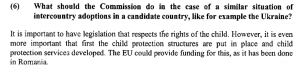
Realising that Romania’s stoppage would have effects on other countries, we (me and some colleague civil servants) started working on a policy document to get to a coherent policy on the issue of children’s rights and intercountry adoption. Also, a meeting was held with the chairman of the Independent Panel on how to deal with other countries, like for example Ukraine.

Full Minutes

As is known now, thanks to a number of ‘Ask the EU’ requests for access to documents, the European Commission stopped acting as the Guardian of the Treaty, and instead joined the adoption lobby in its attempts to replace the UN Convention on the Rights of the Child with the pro-adoption biased Hague Adoption Convention.

No coherent policy was developed. It was back to the Wild West of those with an interest in obtaining children.

The European Commission gave the issue of children’s rights back to the child rights NGOs, like Eurochild, Hope & Homes, and Lumos.

Eurochild who considers intercountry adoptions as the bugbear of child protection does not touch the issue. Instead, with Hope & Homes (an NGO that started its activities in Romania) they organised a pan-European campaign on De-Institutionalisation “Opening Doors”.  Closing institutions, but without a child-rights approach – leaving the bugbear of intercountry adoptions untouched. Let’s not forget the European Commission was largely the main financer of Eurochild.

The Ukrainian part of this campaign got partly financed by the UK Law Firm Clifford Chance, which donated 50.000 euros and 500 hours of law firm hours to reform chilights in Ukraine.

Whatever was done exactly is unknown, but Ukraine became the second largest provider of children for adoption, since Romania and later Russia, closed its doors.

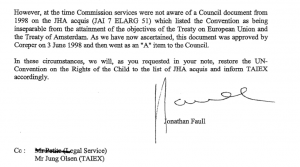
Clifford Chance, by the way, employs the retired Director-General of the Legal Service of the European Commission. He was the boss when, in 2004, the Legal Service did not know that the UN Convention on the Rights of the Child was inseparable of the attainment of the objectives of the Treaty, and thus children’s rights had been deleted from the list of acquis to which new EU Members needed to adhere.

I drafted a letter of complaint, after which child rights got restored:


Another fact, one of the Director-Generals who were part of the Disciplinary Committee who fired me in 2018 was someone I did not know. After his retirement, he also joined that same law firm.

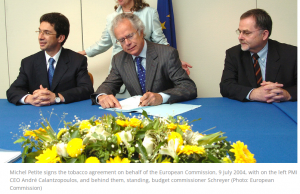
Clifford Chance is known for its tobacco lobby activities for clients including Philip Morris, the Tobacco Advisory Council, and British American Tobacco.

Tobacco lobby tactics:  Michel Petite

Adoption lobbyist Francois de Combret also was involved wiht the tobacco industry.

Anyways, in short: the European Commission did not invest in a reform of the child protection sector like was done in Romania. Letting children at risk of all kind of abuse.

Ukraine is left with a largely unreformed child protection system. Fifteen years were wasted.

I hope the ‘Powers that Be’ will protect Ukrainian children.
There is a great risk for child traffickers now.

As a start, all intercountry adoption procedures should now be suspended.  

Last food for thought: while Mr. Petit taking out the UN Convention on the Rights of the Rights as a legal basis in 2004, this was happening. The world is full of coincidences…

A 1,25 billion dollar deal wiht the tobacco industry

A chronology of the rise and fall of intercountry adoption from Congo

Today we publish the Congolese NGO Dynamique de lutte contre le trafic humain (DCTH)  about illegal adoption and trafficking of human beings, true crimes in silence. It’s in French. In short, it calls for justice for all, and an end to the silence.
And for action at the level of the European Parliament and the European Commission.

We publish this report, with their agreement, because this new human rights organisation has not yet a website.

LINK REPORT


We remind that in 2010, German TV showed how Roelie Post explains the intercountry adoption system – based on the lessons learned from Romania and predicts the upcoming adoption scandal in Congo.

The Dark Side of Adoption, exposed at the European Parliament
On 7 November 2018, the European Parliament Intergroup on Integrity, Transparency, Corruption and Organised Crime showed the Documentary film about the Dark Side of Adoption (in Congo), as part of the series THE TRAFFICKERS

See below’s link to ACT’s chronology, which shows the international connivance with child trafficking for adoption: The US, France, Italy, Netherlands, Belgium, Spain.
But also the European Parliament, the EU Delegation in Congo.

In Belgium a courtcase is ongoing about three stolen children from Congo. One of the children was adopted by a civil servant of the European Commission. A colleague of Roelie Post, so to say. She contacted ACT some years ago, for assistance.
The world upside down, we referred the case back to her employer.

Btw, ACT tried to get the European Anti-Fraud Office to act upon the EU’s financing of child traffickers, but in vain. The European Commission bent over backwards to have the case dismissed in 2018. ACT got condemned to pay the European Commission’s costs, but funny enough we never got the bill.

LINK:  Congo Trafficking Chronology


Success: Dutch Minister of Justice finally acknowledges the UN Convention on the Rights of the Child

ACT has over the years tirelessly advocated for the correct implementation of the United Nations Convention on the Rights of the child in the context of adoption and against the adoption system.

– Adoption is not a child protection measure.

– All alternative care forms are come before intercountry adoptions (Subsidiarity Principle)

Now during the debate on 9th June 2021 in the second chamber of the Dutch parliament, Minister Sander Dekker put´s the UNCRC on the table and concludes that the adoptions from the United States to the Netherlands are in violation of the UN Convention on the  Rights of the Child.

He further questions the practices in which children are removed by child protection services, parental rights being terminated and then the children being put up for adoption / intercountry adoptions against the wish of the parents.

Here are 2 short extracts, subtitled in English. Our hard work pays of.


Arun was adopted and now fights against adoption: ‘authorities refused to provide information all these years’

Source:https://www.ad.nl/buitenland/arun-werd-geadopteerd-en-strijdt-nu-tegen-adoptie-instanties-weigerden-al-die-jaren-informatie-te-geven~a8a91701/(google translation)

There are about 30 million abandoned or orphaned children in India, Indian newspaper The Hindu recently reported . And of these, only about 3,000 are placed with Indian parents every year. Nevertheless, the Netherlands still has an adoption ban. And that’s a good thing, according to activist Arun Dohle of the organization Against Child Trafficking. “There is almost never real voluntary consent from the biological parent.”